
Breathwork & Brainwaves: How to Induce Alpha and Theta States
What We'll Cover
- The 4 Brainwave States: A Scientific Primer
- How to Increase Alpha Brainwaves (The "Calm Focus" State)
- Theta Breathwork: Accessing the Subconscious
- What to Expect When You Enter the Theta State
- Enhancing the Shift: Sonic Neural Breathwork & EFT Techniques
- Experience the Science: Join Us or Become a Guide
- Frequently Asked Questions
The human brain is such an incredible, and electric organ. Every thought you have, every emotion you feel, and every stressor you encounter is accompanied by a hum of electrical activity. These patterns of activity, known as brainwaves, are like different channels on a radio, each with its own unique frequency and associated state of mind.
If you have ever felt completely overwhelmed and unable to focus, it might be because your brain is stuck on a high-stress frequency. The incredible news is that you do not have to stay there and we have tools to help you shift the frequency!
We often think of the breath as just a way to get oxygen into the body, but in reality, breathwork acts as the remote control for your brain. By consciously changing the rhythm and depth of your breathing, you can physically alter your brain's electrical output. Whether you want to drop into a state of calm focus or access deep subconscious healing, understanding the science of brainwaves and breathwork empowers you to intentionally change the channel.
The 4 Brainwave States: A Scientific Primer
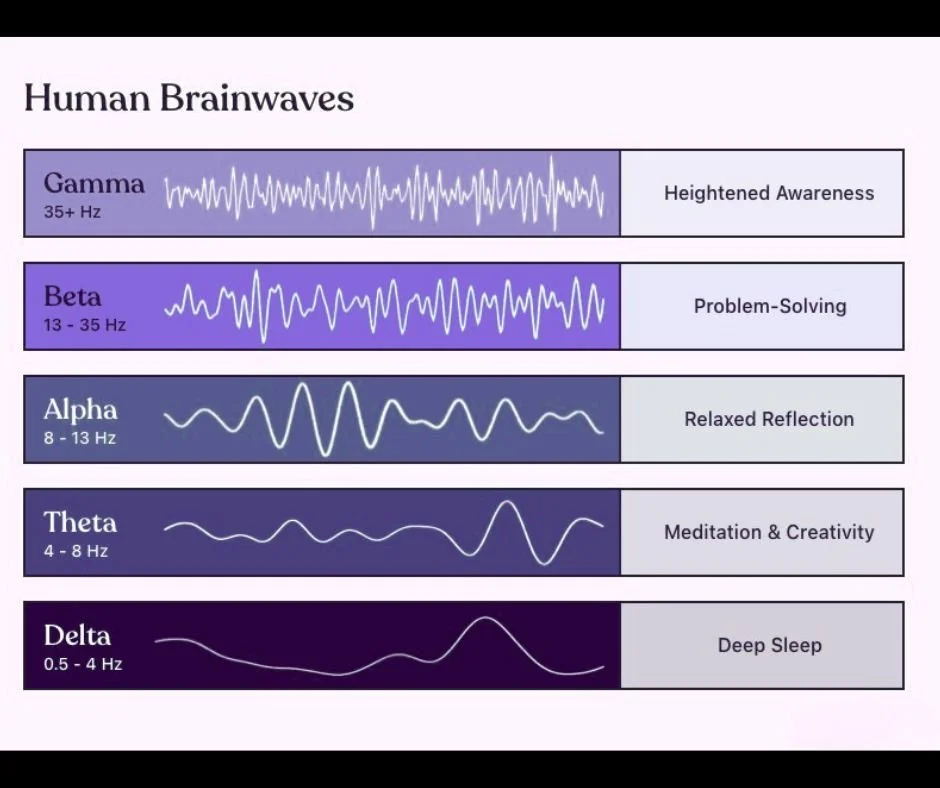
Before we look at which specific breathing techniques trigger which brainwaves, we need to understand the frequencies our bodies operate on. Did you know that our thoughts have frequencies? The frequencies are measured by an EEG (electroencephalogram) in Hertz (Hz).
Here are the four primary brainwave states you move through:
1. Beta Waves (14–30 Hz): The Waking State
This is our everyday waking state, characterized by alertness, logic, and critical thinking. When you are answering emails, navigating traffic, or problem-solving, you are in Beta. However, excessive Beta activity is the hallmark of chronic stress, anxiety, and a dysregulated nervous system.
2. Alpha Waves (8–13 Hz): Calm & Focused
As you close your eyes and begin to relax, your brain transitions into the Alpha state. This is a state of calm alertness, often associated with "flow state," light meditation, and deep presence. Alpha waves act as the bridge between the conscious and subconscious mind.
3. Theta Waves (4–7 Hz): The Subconscious
Theta waves are associated with deep relaxation, vivid imagery, and intuition. This is the realm of the subconscious mind. In children under the age of seven, Theta is the predominant brainwave state, which is why they are so imaginative and deeply suggestible. In adults, we usually only pass through Theta for a few fleeting moments just before we fall asleep or wake up. Have you ever solved your trickiest problems just before falling asleep or just after waking up? That’s the magic of Theta waves.
4. Delta Waves (0.5–3 Hz): Deep Healing Sleep
Delta waves are the slowest brainwave frequency, characteristic of deep, dreamless sleep. This is the state where the physical body performs its deepest restorative healing and where many of us are not spending enough time.
Our goal with breathwork is usually to move the brain out of a frantic doing Beta state and gently guide it down into the restorative Alpha and Theta frequencies.
How to Increase Alpha Brainwaves (The "Calm Focus" State)
When you are stressed, your brain is firing rapid, erratic Beta waves. To find a state of calm focus, we need to slow that electrical activity down. Scientific EEG (electroencephalogram) studies have shown that specific breathing techniques are one of the fastest, most reliable ways to increase Alpha brainwaves.
Here are the most effective techniques to shift your brain into an Alpha state:
Diaphragmatic Breathing (Belly Breathing)
Every time you take a shallow chest breath, you send a panic signal to your brain. Conversely, diaphragmatic breathing increases Alpha waves by stimulating the vagus nerve. When you breathe deep into your belly, the vagus nerve releases acetylcholine, a neurotransmitter that lowers your heart rate and tells your brain you are completely safe. An EEG will show an almost immediate smoothing of brainwave activity as the brain drops from stressed Beta into calm Alpha.
If you’d like a guided practice, and more information, check out our Diaphragmatic Breathing Technique page.
4-7-8 Breathing
The 4-7-8 breathing technique has been shown in EEGs to be a very powerful breathwork technique for increasing Alpha waves. The 4-7-8 technique involves inhaling for 4 seconds, holding for 7, and exhaling for 8. Because the exhale is twice as long as the inhale, it acts as a massive brake pedal for the nervous system. The breath retention (the hold) creates a mild shift in carbon dioxide levels, which gently dilates blood vessels in the brain, creating a flood of Alpha waves.
If you’d like a guided practice, and more information, check out our 4-7-8 Breathing Exercise page.
Box Breathing
Used by Navy SEALs and athletes, box breathing (inhale 4, hold 4, exhale 4, hold 4) requires just enough concentration to stop racing thoughts, but not enough to cause stress. This steady, rhythmic pattern creates what neuroscientists call "heart-brain coherence," which reliably produces a strong, stable Alpha brainwave state.
If you’d like a guided practice, and more information, check out our Box Breathing Technique page or follow along with our guided Box Breathing breathing exercise.

Theta Breathwork: Accessing the Subconscious
While Alpha is the bridge, Theta is the deep dive. Theta breathwork practices, such as Conscious Connected Breathwork (CCB), are designed to push the brain past the Alpha state and down into the deep, restorative Theta frequencies.
This is done using a continuous, circular breathing pattern with no pauses between the inhale and the exhale. After about 10 to 15 minutes of this active breathing, the prefrontal cortex which is the analytical, overthinking part of your brain, temporarily powers down. This phenomenon is called "transient hypofrontality."
This is so powerful because when the analytical mind steps out of the way, your brain drops into a dominant Theta state. Because Theta is the brainwave of early childhood (under age seven), entering this state as an adult creates a massive window of neuroplasticity, where your brain is open to change. This allows you to access deeply held subconscious beliefs, process old memories, and literally rewire your neural pathways.
What to Expect When You Enter the Theta State
When you transition from the logical Beta state, through the calm bridge of Alpha, and down into the deep waters of Theta, your experience of reality temporarily shifts. Because the analytical mind has powered down, you are no longer "thinking" your way through the session; you are feeling and experiencing it on a subconscious level.
So, what does this actually feel like? When practicing deep breathwork like Conscious Connected Breathwork, you might experience a range of phenomena:
Active Imagination and Visions: Because Theta is the brainwave of dreams and deep meditation, you might experience vivid imagery, sudden creative insights, or flashes of old memories. Carl Jung referred to this as active imagination, a way to consciously interact with your subconscious mind.
Physical Sensations: As energy moves through the body, it is entirely normal to feel temperature fluctuations (suddenly hot or cold), tingling in the hands and face, or a deep sense of physical weightlessness.
Emotional Release (Crying During Breathwork): This is one of the most common, yet misunderstood experiences. If you suddenly find yourself crying during breathwork, laughing, or shaking, it means the practice is working perfectly. When the ego goes offline in Theta, your nervous system finally feels safe enough to discharge stored somatic memory and trapped stress. It is a deeply biological, physiological release that we welcome completely in a trauma-informed space.

Enhancing the Shift: Sonic Neural Breathwork & EFT Techniques
While the breath alone is enough to change your brainwaves, you can accelerate and deepen this entrainment by combining breathwork with other somatic and sensory tools. Here are few you can try:
Sonic Neural Breathwork
Sound and breath are a perfect neurobiological match. Sonic neural breathwork involves pairing intentional breathing patterns with specific sound frequencies that affect the brain. By listening to binaural beats or specific body frequencies (like the 432 Hz Earth frequency) while you breathe, you use "brainwave entrainment" to gently force the brain to sync with the audio track, dropping you into Alpha or Theta much faster than breathing alone.
EFT Tapping Therapy
The EFT method (Emotional Freedom Techniques) is another incredible tool to use alongside breathwork. EFT techniques involve gently tapping on specific acupressure points on the body (like the collarbone, temples, and wrists) while focusing on a specific emotion and taking deep, regulating breaths. Clinical studies show that EFT techniques therapy significantly lowers cortisol levels. By pairing the physical tapping with diaphragmatic breathing, you signal profound safety to the amygdala (the brain's fear center), making it much easier to transition out of a stressed Beta state.
Want to Experience the Science? Join Us or Become a Guide
Reading about brainwaves is one thing, but feeling your own nervous system drop from a frantic Beta state into a state of profound Theta peace is life-changing.
Ways to Experience It Yourself
If you want to intentionally change your brain's channel, we invite you to join us. Check out our Breathwork Events page, where we host live online and in-person events, workshops, and deep-dive retreats. If you are just starting out, you can also join our regular Free Breathwork sessions to experience the calming power of Alpha brainwaves in a safe, guided, and trauma-informed community.
Go Deeper: Breathwork Facilitator Training
For those who are fascinated by the science of the breath and want to learn how to ethically hold space for others, our trauma-informed training pathways are designed for you. We go far beyond just teaching techniques; we teach you the deep neurobiology of the human body.
You will learn exactly how to support clients as they navigate the vulnerable Theta state, how to process emotional releases safely, and how to build a professional, globally accredited practice. Whether you start with our 50-Hour Trauma Sensitive Breathwork Coach Certification or go all-in on our 400-Hour Professional Breathwork Facilitator pathway, you will graduate with the tools, the science, and the confidence to guide profound transformation.
Frequently Asked Questions
-
Yes. Deep, diaphragmatic breathing stimulates the vagus nerve and activates the parasympathetic nervous system. EEG studies consistently show that this physical relaxation creates an immediate increase in Alpha brainwaves, which are associated with calm, focused presence.
-
The 4-7-8 breathing technique primarily induces Alpha waves. The long, extended exhale acts as a brake pedal for the nervous system, pulling the brain out of a stressed Beta state and into a relaxed Alpha state. While it can prepare the body for sleep, deep Theta waves are typically achieved through longer, continuous circular breathing practices (or as you actually fall asleep).
-
Alpha waves are not actually a stage of deep sleep; rather, they are the bridge to sleep. You experience Alpha brainwaves during the initial wind-down phase when you close your eyes, relax your muscles, and prepare to drift off (Stage 1 sleep transition).
-
Theta breathwork refers to longer, connected breathing practices (like Conscious Connected Breathwork) designed to bypass the analytical mind and induce a dominant Theta brainwave state. This allows practitioners to access the subconscious mind, process somatic trauma, and experience deep emotional releases.