
The Science of Breathwork
What We Cover
A Short Guided Tour of the Respiratory System
The Surprising Role of Carbon Dioxide
Your Breath and Your Nervous System
The Science of Calming Breathwork
The Power of the Extended Exhale
What Makes Conscious Connected Breathwork Different?
What Other Sensations You May Experience in a CCB Session
The moment you decide to change your breath, you are taking control of a system that has been running on autopilot since the second you were born. In an instant, you can choose to move from being lived by your biology to actively steering it. This conscious shift is the foundation of breathwork.
The breath is incredible in that it is the only vital function that is both completely automatic and under our direct conscious control. You don't have to remind your heart to beat or your liver to filter toxins, and you (probably) couldn't if you tried. But the breath is governed by the autonomic nervous system, yet you can reach out and grab the controls at any time.
Breathwork, in its most basic definition, is the intentional use of this control. More broadly defined, it is the practice of manipulating the rate, depth, and pattern of breathing to achieve specific physical, psychological, or even altered-state effects.
It is important to take a minute to acknowledge that "breathing" does not look or feel the same for everyone. For some, nasal breathing is a challenge due to deviated septums or chronic congestion; others may navigate life with tracheostomies, asthma, or neurodivergent sensory processing that makes certain sensations of the breath feel overwhelming. So, although we strive for nasal breathing, or deep breathing, the "perfect" breath is a myth, there is only the breath that is available to your body at this moment.
You've been breathing your whole life. But you might not know what’s actually happening when you do. In this article, we’ll cover everything from the air entering your nostrils, down to the microscopic exchange in your cells, and into the deep architecture of your nervous system.
A Short Guided Tour of the Respiratory System
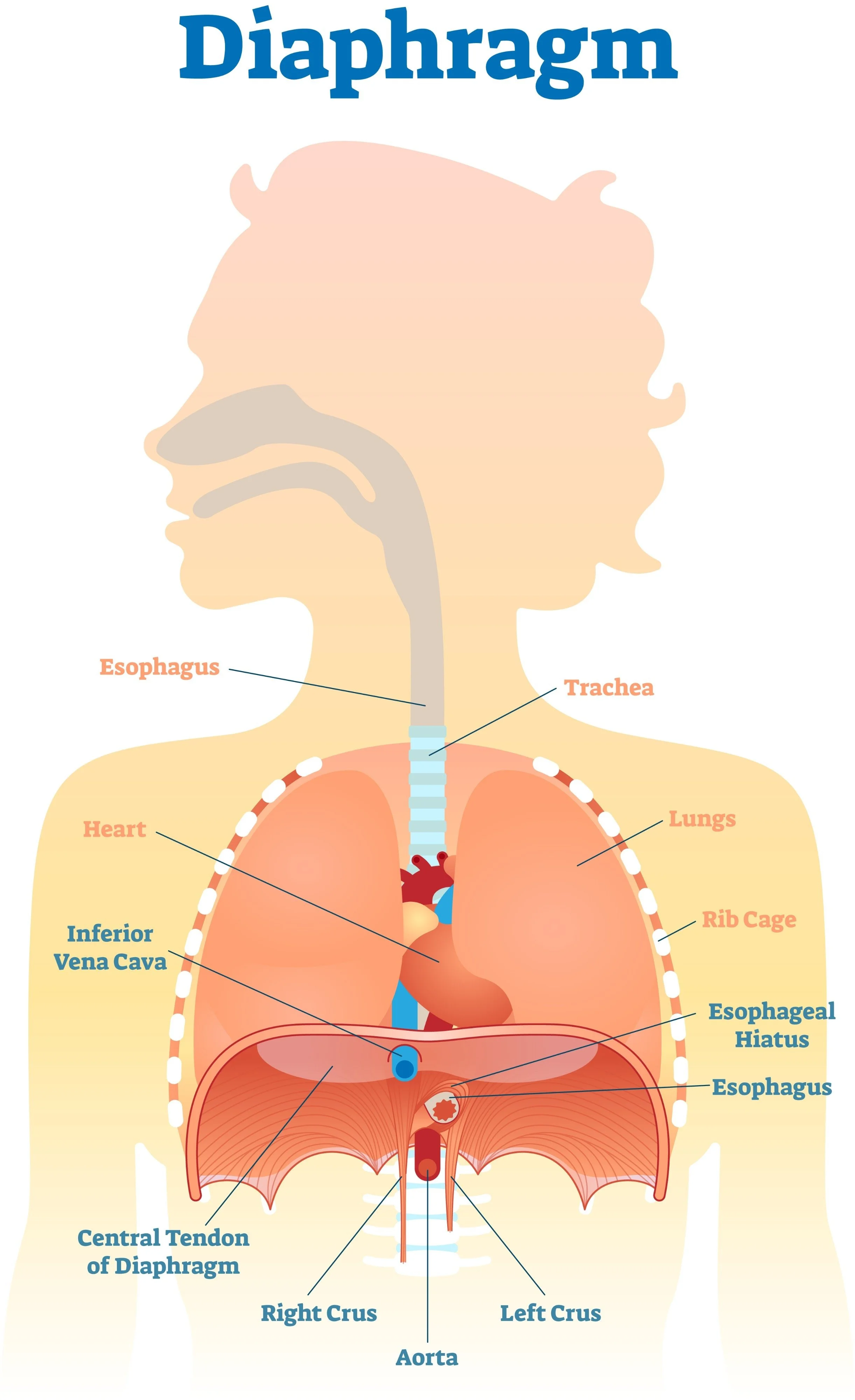
To understand breathwork, we must first understand the machinery that allows us to breathe. The respiratory system is an intricate network of tubes and sacs designed for one primary purpose: getting life-sustaining gases in and out of your bloodstream.
The Upper Airways
Your nose is more than just a facial feature; it is also a sophisticated air-conditioning unit. It filters, warms, and humidifies the air before it reaches the delicate tissues of the lungs. Nasal breathing also encourages the production of nitric oxide, a vasodilator that helps increase oxygen transport. While the mouth is a perfectly functional backup, especially during high-intensity exercise or certain breathwork practices, the nose is the body's preferred primary intake.
The Trachea & Bronchial Tree
Once past the pharynx (back of the throat) and larynx (voice box), air travels down the trachea (air tube), which splits into two main bronchi. These then branch out into thousands of smaller tubes called bronchioles. Think of it as an upside-down tree, where the air moves through increasingly narrow branches until it reaches its destination.
The Alveoli
At the end of these branches sit the alveoli which are tiny, grape-like clusters of air sacs. There are roughly 300 to 500 million of them in your lungs. Their walls are only one cell thick, allowing gases to pass through them and into the surrounding capillaries with ease. This is where the magic of gas exchange happens: oxygen enters the blood, and carbon dioxide leaves it.
The Diaphragm
The diaphragm is a large, dome-shaped muscle sitting right at the base of your ribs. When you inhale, it contracts and moves downwards, creating a vacuum that pulls air into the lungs. Diaphragmatic breathing simply means allowing this muscle to do its job fully, rather than relying on the "accessory muscles" in your chest, neck, and shoulders.
While we often call this "belly breathing," it is worth noting that your anatomy is unique. Surgery, chronic pain, or physical disability can change how your diaphragm moves. The goal isn't specifically of the belly moving, but rather an efficient use of the space available to you.
The Surprising Role of Carbon Dioxide
Most of us grew up believing that oxygen is "good" and carbon dioxide (CO₂) is simply "waste." The reality is far more nuanced. CO2 is actually incredibly important in controlling breathing behind the scenes! Here are some important ways that CO2 helps you in breathing:
Oxygen’s Journey
When you inhale, oxygen diffuses across the alveoli and binds to haemoglobin in your red blood cells. However, getting oxygen into the blood is only half the battle. To actually use that oxygen, your cells need the haemoglobin to let go of it.
This is governed by the Bohr effect. This physiological principle states that haemoglobin’s affinity for oxygen is inversely related to the acidity of the blood and the concentration of carbon dioxide. In simpler terms: you need a certain level of CO2 in your blood to "unlock" the oxygen so it can move into your tissues and brain. If you breathe too much CO2 out (through chronic over-breathing or hyperventilation), the oxygen stays stuck to your haemoglobin, and your tissues actually become oxygen-starved over time.
Cellular breathing (ATP)
Your cells use that oxygen to produce Adenosine Triphosphate (ATP), the primary energy currency of the body. Without efficient gas exchange, cellular energy production slows down, leading to fatigue and "brain fog."
pH and CO2 tolerance
Your breath is the fastest way to regulate your blood pH. Carbon dioxide is acidic. When you hold your breath, CO2 builds up and pH drops (becoming more acidic). When you breathe rapidly, CO2 drops and pH rises (becoming more alkaline). Many breathwork practices focus on increasing your "CO2 tolerance," training your nervous system to remain calm even when acidity levels rise slightly.
Your Breath and Your Nervous System
The most profound impact of breathwork is its ability to interact directly with the Autonomic Nervous System (ANS). The ANS has two primary branches:
The Sympathetic Nervous System (SNS): The "accelerator." It prepares the body for action, stress, or perceived danger (fight or flight).
The Parasympathetic Nervous System (PNS): The "brake." It promotes rest, digestion, and recovery.
Here are some ways your nervous system and your breath interact:
The Vagus Nerve and the "Brake"
The vagus nerve is the longest nerve of the ANS, running from the brainstem down through the chest and abdomen. It is the primary highway for the parasympathetic system. When you engage in slow, deep, diaphragmatic breathing, specifically with an extended exhalation, you send a signal through the vagus nerve to the brain that "all is well." This triggers a decrease in heart rate and a state of calm.
Heart Rate Variability (HRV)
HRV is the measure of the variation in time between each heartbeat. A high HRV is a sign of a flexible, resilient nervous system that can switch easily between stress and rest. Breathwork is one of the most effective ways to improve HRV.
Respiratory Sinus Arrhythmia (RSA)
This is a natural phenomenon where your heart rate increases slightly on the inhale (SNS activation) and decreases on the exhale (PNS activation). By consciously lengthening the exhale, you lean into that natural "braking" mechanism to down-regulate your entire system.
The Locus Coeruleus
Deep in the brainstem sits the locus coeruleus, a cluster of neurons that is the brain's primary source of noradrenaline (the "alertness" chemical). It is incredibly sensitive to CO2 levels and the rhythm of nasal breathing. This is why a sudden sharp inhale makes you feel instantly more alert, you are literally "waking up" the brain’s alarm system.
The Science of Calming Breathwork
When we use breathwork for relaxation, we are essentially hacking the feedback loop between the body and the brain. Here are some examples of slow, steady controlled breathing practices can help with stress management, stress response and stress reduction:
| Technique | Primary Mechanism | Typical Effect |
|---|---|---|
| Box Breathing | Equal inhale / hold / exhale / hold | Stabilises the nervous system; builds CO2 tolerance. |
| Extended Exhale | Exhale is twice as long as inhale | Strong vagal activation; lowers heart rate quickly. |
| Diaphragmatic | Deep, low-frequency breathing | Reduces cortisol; lowers blood pressure over time. |
| Alternate Nostril | Shifting breath between nostrils | Can help balance the autonomic nervous system. |
The Power of the Extended Exhale
If you are feeling anxious, the most effective tool in your kit is the long exhale. By slowing the out-breath, you are mechanically forcing the nervous system to shift out of a sympathetic state. This reduces the production of cortisol and adrenaline, making it a powerful intervention for sleep quality and acute stress.
If you want a guided video demonstration and more information, head to Extended Exhale breathing technique.
What Makes Conscious Connected Breathwork Different?
While slow breathing is about regulation, Conscious Connected Breathwork (CCB) is often about transformation or altered states. CCB involves a continuous, rhythmic pattern of breathing where the pause between the inhale and exhale is eliminated.
The Physiology of the Connected Breath
In a CCB session, you are intentionally increasing your ventilation. This leads to hypocapnia, a significant drop in blood carbon dioxide levels. As we learned with the Bohr effect, when CO2 drops, the blood becomes more alkaline (alkalosis). This causes several incredible things to happen:
Reduced Cerebral Blood Flow: The alkalosis causes a slight constriction of blood vessels in the brain, particularly in the prefrontal cortex which is the part of the brain responsible for our "inner critic," logic, and sense of self. When this area "quiets down," people often report feeling a sense of ego-dissolution or deep emotional clarity.
Tetany: You may experience tingling in the hands or feet, or even a temporary cramping known as tetany. This is not dangerous; it is simply a result of calcium ions becoming more bound to proteins in the blood due to the shift in pH. It usually resolves as soon as the breath returns to normal.
Brainwave Shifts: Research shows that CCB can shift brainwaves from the everyday "Beta" state into "Alpha" (relaxed) or even "Theta" (the state associated with dreaming and deep meditation).
The Altered States of CCB
This chemical shift can trigger the release of endorphins and may involve other neurochemical changes that create a "natural high" or an altered state of consciousness. This is why CCB is often used for emotional release or "somatic" processing, allowing the body to "shake off" old stress or trauma cycles that have been stored in the nervous system.
Safety Note: Because of these intense physiological shifts, CCB is not suitable for everyone. Those with cardiovascular conditions, epilepsy, severe asthma, or certain mental health presentations (such as psychosis) should consult a professional. Always work with a trained facilitator who understands how to pace the experience.
What Other Sensations You May Experience in a CCB Session
If you move into the territory of connected breathing, the experience is rarely just "sitting and breathing." It is a full-body event.
Physical Sensations: Along with the tingling or tetany mentioned above, you might feel temperature fluctuations suddenly feeling very hot or very cold. This is your autonomic nervous system recalibrating.
Emotional Surges: It is incredibly common for people to experience waves of grief, joy, or even rage. Without the "logical" brain filtering everything, the body often takes the opportunity to complete emotional cycles that were suppressed in daily life.
Perceptual Shifts: Some people experience visual phenomena or a distorted sense of time. These are not "hallucinations" in the traditional sense, but rather the result of your brain operating in a different electrical frequency (Theta).
Integration: The period after a session is just as important as the breathing itself. Your brain is in a state of high neuroplasticity which is a window of openness where new insights can be integrated into your life more easily.
Want to know more about benefits of breathwork? Learn more about the benefits and science behind breathwork at our Benefits of Breathwork page.
Going Further With Breathwork Training
At Breathing Space, we hold a "yes, and" mentality. We believe there is room for mystery, magic, and science together. We don’t believe that understanding the Bohr effect, the vagus nerve, or the chemistry of CO2 makes breathwork any less "spiritual." If anything, the science makes the practice more remarkable as it proves that we carry a profound, built-in system for self-regulation and discovery right inside our own ribcages.
If this exploration has sparked a desire to go deeper into the science of breathwork or why breathwork is so powerful, we offer two structured paths:
Breathwork Coach: Our 50-hour coaching course provides a clear, accessible entry point into the science and practical application of breathwork for those looking to integrate these tools into their existing work.
Breathwork Facilitator Training: Our 400-hour training is a comprehensive deep dive. It is designed for those ready to guide others through complex physiological and emotional landscapes using a grounded, trauma-informed approach rooted in anatomy and nervous system mapping.
FAQ: Common Questions About Breathwork
What does breathwork do to your body?
It regulates your blood pH, influences your heart rate, and shifts the balance of your autonomic nervous system. Depending on the technique, it can either calm you down (by activating the vagus nerve) or energise you (by temporarily altering blood chemistry).
Can breathwork really calm the nervous system?
Yes. By slowing the breath and lengthening the exhale, you mechanically trigger the parasympathetic nervous system, which lowers your heart rate and reduces stress hormones like cortisol.
Why do people get tingling or cramps during breathwork (tetany)?
This occurs during faster breathing patterns (like CCB). As you breathe out more $CO_2$, your blood becomes more alkaline, causing calcium ions to shift. This creates a temporary tingling or "cramping" sensation that is safe and disappears once you return to a normal breathing rate.
Is breathwork the same as meditation?
While both can be "meditative," they are different. Meditation usually involves observing the mind or a focus point, whereas breathwork involves actively changing a physiological process to influence the mind and body.
Which muscle is responsible for most of our respiratory effort?
The diaphragm is responsible for about 75% of your respiratory effort. When it functions correctly, it moves like a piston, allowing for efficient air intake and better nervous system regulation.