
Why Choose a Trauma-Informed Breathwork Training?
What We'll Cover
- Making Room for More Than a Big Release
- What Does Trauma-Informed Actually Mean?
- From Trauma-Unaware to Trauma-Informed
- Why This Matters Beyond Trauma
- Why Our Coach and Facilitator Trainings Use Different Labels
- Questions to Ask Before You Choose a Training
- What If You’re Already Qualified?
- Why Choose a Trauma-Informed Breathwork Training?
If you’ve had a powerful breathwork experience, you may have come away thinking, “I’d love to share this with other people.”
That’s where many of us begin, including Benedict. During his first experience with Conscious Connected Breathwork something powerful shifted. It opened up a possibility, and he knew he had to learn how to bring this out into the world.
When you start comparing breathwork trainings, though, there’s more to consider than the breathing technique.
What will you learn about supporting someone whose experience is very different from yours?
What happens when someone wants to stop?
How will you learn to recognise the limits of your role?
Along the way, you’ll probably encounter the phrase trauma-informed. We believe it’s a very important part of breathwork training but it’s worth asking what a school means by it and how that understanding shows up in the training itself.
Making Room for More Than a Big Release
Some breathwork spaces have placed a lot of value on cathartic experiences such as crying, shaking, expressing strong emotion or having what gets described as a breakthrough. People may be encouraged to breathe harder, push through discomfort or revisit painful experiences in pursuit of a release.
That approach can leave people overwhelmed, exposed or feeling worse afterwards. Encouraging someone to stay with distress because we believe it will lead to healing can override the very signals they need to be able to listen to.
We don’t believe breathwork should be used to dig into someone’s painful experiences or draw out emotions they haven’t chosen to explore. People don’t need to uncover a hidden wound or relive something difficult to benefit from working with their breath.
Feelings and memories may arise, and we can meet them with care. That means listening to the person, offering choices and supporting them to pause or stop when they want to. We don’t need to intensify what’s happening, interpret it for them or turn it into a process they never asked for.
For someone who is used to pushing past their own limits, being able to say “That’s enough” and have it respected may matter a great deal.
As our understanding develops, we have a responsibility to reconsider what we teach and encourage. When we know better, we can do better, and that includes letting go of the idea that more intensity means more benefit.

What Does Trauma-Informed Actually Mean?
Imagine you’re attending a training exercise. The teacher explains what will happen, offers alternatives and tells you how to pause. When you decide to observe, they accept your choice without asking you to explain it to the group.
That tells you something about the training’s approach.
Trauma-informed practice recognises that past experiences can affect how people respond to instructions, authority, physical sensations, touch and group settings. It uses that understanding to shape the way people are taught and supported.
In practice, this means paying attention to:
Safety: reducing avoidable risks and listening to what helps people feel safer.
Trust: explaining expectations, boundaries and decisions clearly.
Choice: making it possible to adapt, decline or stop.
Collaboration: working with people and taking their feedback seriously.
Empowerment: respecting their knowledge of their own experience.
Cultural consideration: recognising how background, identity and experiences of discrimination may affect participation.
No facilitator can guarantee that everyone will feel safe.
We can create clearer expectations, offer meaningful choices and respond thoughtfully when someone tells us something isn’t working.
Working in this way also requires clear boundaries. Being trauma-informed on its own does not qualify a breathworker to diagnose or treat trauma.
From Trauma-Unaware to Trauma-Informed
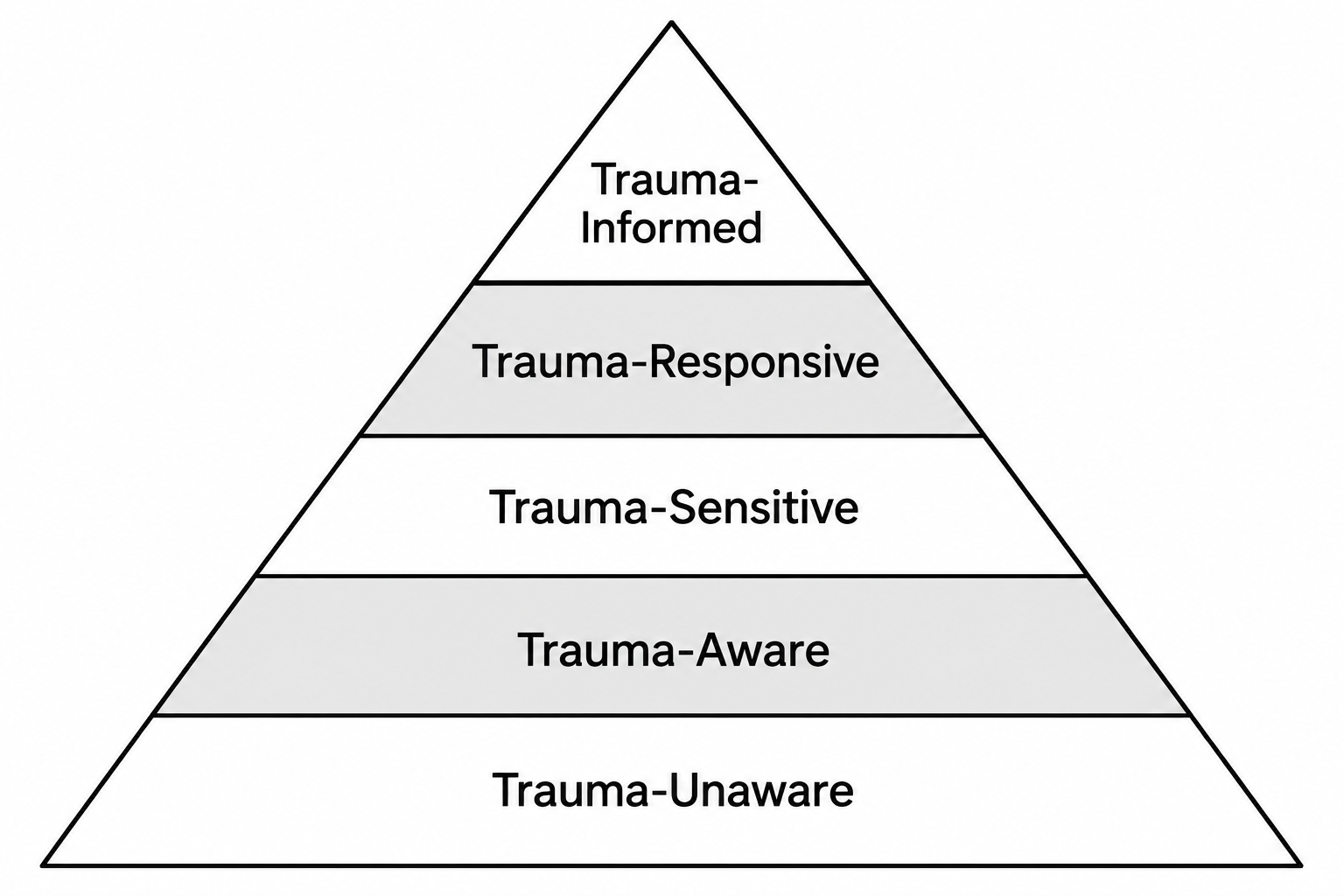
These terms can get confusing, especially when different schools use them differently.
We find the following spectrum useful for explaining how understanding can develop into practice.
Here’s a guide to the distinctions we’re making, rather than a universally agreed grading system.
| Approach | What It Means Here |
|---|---|
| Trauma-unaware | Trauma and its possible effects receive little or no consideration in teaching or facilitation. |
| Trauma-aware | Recognises that trauma can influence someone’s experience, but may offer limited guidance on what to do with that knowledge. |
| Trauma-sensitive | Applies that understanding through considerate language, pacing, consent and choices within a clearly defined scope. |
| Trauma-responsive | Actively adapts practices, environments and support in response to people’s needs and feedback. |
| Trauma-informed | Embeds this understanding throughout the curriculum, teaching, practice, assessment, policies and support. |
The terms naturally overlap.
Someone working in a trauma-informed way should also be sensitive and responsive. The useful question is how consistently these principles shape what happens.
A course might teach a detailed lesson about consent, for example, while making students feel they cannot decline an exercise. That gap in experience matters.
Students learn from how their teachers behave as well as from what they say.
Why This Matters Beyond Trauma
You don’t need to disclose a trauma history to benefit from clear instructions, predictable expectations and choices about participation. We believe that trauma-informed design is really human-centered design.
You might be autistic and find the music overwhelming. You might have ADHD and lose track of a long explanation. You might be exhausted, learning in a second language or trying to process unfamiliar material while dealing with a difficult week.
These are very different experiences that will impact the individual’s ability to process and take in information and they all deserve individual consideration.
Cognitive load describes how much mental work something asks of us. Listening to an explanation, remembering a breathing pattern, noticing sensations, hearing the person next to you, and deciding what to do next can be quite a lot at once.
A thoughtful training can reduce unnecessary demands by:
Giving instructions in manageable steps.
Providing written information alongside spoken explanations.
Allowing processing time and breaks.
Discussing sensory needs and possible adjustments.
Offering alternatives to compulsory sharing or particular body positions.
Explaining what participation and assessment involve.
Accessibility also requires a willingness to ask what works for each person regardless of trauma. Trauma-informed principles can support that approach by encouraging us to listen, collaborate and avoid assuming everyone needs the same thing.
Why Our Coach and Facilitator Trainings Use Different Labels
At Breathing Space, our courses are designed around trauma-informed principles. But the amount and depth of trauma education vary with the purpose of each course.
There are two questions here: how is the course taught, and what does it prepare graduates to offer?
Our 50-hour Breathwork Coach Training provides a foundation in breath regulation, nervous system understanding, consent, pacing, boundaries and accessible coaching. We describe its preparation as trauma-sensitive to reflect that focused scope.
Coaches learn to offer choices, adapt practices within their training and recognise when further support is needed. The course does not train graduates to facilitate Conscious Connected Breathwork or provide trauma therapy.
Our 400-hour Breathwork Facilitator Training includes the Coach foundation and develops these subjects in greater depth, alongside preparation for Conscious Connected Breathwork and individual and group facilitation. More extensive learning, supported practice, feedback and reflection provide the basis for its trauma-informed approach.
The distinction reflects the preparation each pathway offers.
We want the label to help you understand what you’re learning and the responsibilities that come with it.
Questions to Ask Before You Choose a Training
A discovery call is an opportunity for you to assess the training and the people teaching it. You should feel comfortable asking hard questions, taking your time and leaving without making a decision.
You don’t need to know all the terminology.
Ask about what actually happens:
Can I decline or adapt an exercise? How will that choice be handled?
How much trauma education is included? How will I practise applying it?
What feedback will I receive? Who will observe and support my facilitation?
How do you accommodate different needs? Ask about any adjustments relevant to you.
What will I be qualified to offer? What remains outside my scope?
How can students raise concerns? What happens if they question a teacher or disagree with an approach?
What is the full financial commitment? Ask about additional costs, payment plans and cancellation terms.
Listen for specific answers, and notice how your questions are received.
Do they welcome them?
Can they acknowledge the limits of their course?
Do you have room to think, or does every concern become something they try to overcome so you’ll enrol?
Pay attention to your own intuition too. How do you feel during and after the conversation? Interested? Heard? Rushed? Reluctant to disagree? You don’t have to explain away an uneasy feeling. Give yourself time to consider it alongside the curriculum, policies and other information you’ve gathered.
Some red flags worth paying attention to include:
Pressure to decide immediately: countdown timers that reset, supposedly one-time offers or discounts available only if you pay during the call.
Using your vulnerability to sell: suggesting that hesitation proves you’re afraid of growth, or that enrolling is necessary for your healing.
A teacher placed beyond question: a “guru” culture where loyalty is expected, disagreement is discouraged or one person claims to have all the answers.
Promises of guaranteed transformation: claims that the training will heal your trauma, change everyone’s life or guarantee a particular income.
Pressure to disclose or push through: compulsory sharing of painful experiences, emotional release treated as an achievement or stopping interpreted as resistance.
Vague answers about competence: impressive titles without clear explanations of assessment, supported practice or what graduates can responsibly offer.
Unclear accountability: no accessible complaints process, dismissive responses to concerns or an expectation that difficulties stay within the group.
A genuine enrolment deadline or limited number of places can be explained clearly, with time for you to make an informed decision. Notice whether that information helps you plan or is being used to rush you.
The way a school treats you before you enrol gives you useful information about its teaching culture. Look for people who respect your questions, your boundaries and your right to decide that their course may not be the right fit.
What If You’re Already Qualified?
Perhaps your original training gave you useful skills but spent little time on trauma, accessibility or consent. As your work develops, you may notice questions you want more help answering.
The great news is that you can build on what you already know!
Our bridging CPD programme, The Trauma-Informed Wellness Professional, is developed for breathworkers and other wellness professionals who want to deepen this part of their practice.
It explores choice, power, boundaries, responses to distress and adapting the way we support people. You can join the waitlist for course details.
You can also explore our other CPD trainings for focused professional development.
You are very welcome at Breathing Space, no matter what your training lineage.
So, Why Choose a Trauma-Informed Breathwork Training?
Ultimately, the training you choose will shape how you support people. You’ll learn from the way your teachers respond when someone struggles, changes their mind or asks a difficult question. Those experiences help form your understanding of what it means to guide others.
A trauma-informed training should help you develop the understanding and judgement to work with people whose needs and experiences differ from yours. That includes recognising when to adapt, when to pause and when someone needs support beyond your role. These skills matter whichever breathing practices you go on to offer.
If you’re beginning your journey, explore our 50-hour Breathwork Coach Training or 400-hour Breathwork Facilitator Training, depending on the practices you want to guide. If you’re already qualified and want to deepen this part of your work, take a look at The Trauma-Informed Wellness Professional.