
Grounding and Resourcing in Breathwork: What They Are and How to Use Them
Practices like Conscious Connected Breathwork (CCB) and other somatic breathwork modalities like holotropic breathwork can be incredibly powerful opening doors to deep healing and self-discovery in a way that very few other modalities offer. But they can also stir up a lot of emotion and unearthing traumas or unhealed wounds.
While emotional release can be deeply integrative, it can also be destabilising. If a breather’s nervous system becomes overwhelmed, the experience stops being therapeutic and starts being re-traumatising.
This is where grounding and resourcing come in. In trauma-informed space holding grounding and resourcing they are non-negotiable tools. They provide the anchors that help individuals navigate the depths of their experience with choice and strength.
We have created this guide to what grounding and resourcing actually are, how to use them, and detailed instructions for building your own toolkit.
What are Grounding Techniques?
When you experience severe anxiety, dissociation, or the edge of a panic attack during breathwork, your nervous system is reacting as if a past threat is happening right now. Grounding techniques are specific practices designed to pull your brain and body out of the past (or future) and anchor you firmly in the present moment.
They send a direct, somatic signal to your nervous system that you are safe, right here, right now.
What is Resourcing?
Resourcing is the practice of tapping into internal or external sources of comfort, strength, and support. It provides the nervous system with a felt sense of safety and capacity, making it easier to be with difficult sensations without becoming overwhelmed by them.

The Golden Rule: Practice Before You Need Them
One of the biggest mistakes we see in breathwork spaces, and mental health services more broadly, is handing someone a list of grounding exercises for anxiety only after they are dysregulated.
How Do Grounding Techniques Work?
They work by relying on established neural pathways. When you are in a state of high sympathetic arousal (fight or flight) or dorsal vagal shutdown (freeze or dissociation), the prefrontal cortex which is the logical, learning part of your brain, goes offline.
This means that you cannot learn a new skill while you are having a panic attack.
This is why it’s so important to practice grounding and resourcing techniques when you are calm.
Try them out in your living room.
Practice them while waiting for the kettle to boil.
Figure out which ones your body actually responds to and which ones don’t help you. Finding a few favourites before you need them ensures that when the storm hits, the tools are already familiar and accessible.
When to Use Grounding & Resourcing Techniques
Knowing when to use grounding and resourcing techniques is essential.
You should reach for grounding exercises at the first sign of your "early warning system" being triggered such as feeling "floaty," unmoored, or noticing your vision become blurry. These physical cues often signal that your nervous system is entering a state of high arousal or dissociation. Grounding techniques can force a "hard reset" that pulls your brain out of a mental loop and back into the present moment.
Resourcing techniques are best utilized when you feel a heavy sense of emotional distress or when your body feels like a "minefield" of tension.
In short, you should use grounding when you need to reconnect with reality and resourcing when you need to cultivate a sense of safety within yourself.
Signs It’s Time to Use Grounding (To Reconnect with Reality)
Use these when you feel like you are "leaving" your body or losing touch with your surroundings:
Visual Changes: Your vision becomes blurry, you start staring into space (zoning out), or the room feels "flat" or far away.
Physical Disconnection: Feeling "floaty," lightheaded, or like your limbs don't quite belong to you.
Mental Spirals: Your thoughts are racing in a repetitive loop or you feel a sudden "brain fog" that makes it hard to speak.
Loss of Time: Realizing you don't quite remember the last few minutes or how you got to where you are.
Signs To Use Resourcing (To Find Safety and Comfort)
Use these when the present moment feels "too much" and you need to soften your internal experience:
Physical Tension: Your chest feels tight, your gut is in knots, or your body feels like a "minefield" of uncomfortable sensations.
Emotional Overload: Feeling an intense wave of sadness, anger, or fear that feels too "big" to process right now.
Intrusive Thoughts: Distressing memories or worries start to surface when you are in a place where you cannot safely deal with them (like at work or in public).
Exhaustion: Feeling too emotionally drained or "un-resourced" to engage with your triggers, signaling a need for a mental safe space.
30 Grounding and Resourcing Techniques to Try
Below is a list of 30 different grounding and resourcing techniques to try out. Some might work, some might not. Try them all, keep what works, and leave the rest behind.
1. 5-4-3-2-1 Senses
A classic technique that anchors you to the present by engaging all five senses.
Name 5 things you can see, 4 things you can feel, 3 things you can hear, 2 things you can smell, and 1 thing you can taste.
2. Box Breathing
A slow, rhythmic breathing pattern that calms the nervous system quickly.
Breathe in for 4 counts, hold for 4, breathe out for 4, hold for 4. Repeat 4 times.
3. Feet on the Floor
Drawing awareness to where your body meets the ground.
Press both feet firmly into the floor, notice the texture and pressure, wiggle your toes, and take three slow breaths.
4. Grounding Mantras
A short repeated phrase that interrupts anxious thinking.
Choose a phrase (e.g. "I am here. I am safe. This is now.") and repeat it slowly 5–10 times, pausing between each word.
5. Cold Water on Hands
Temperature is a fast-acting anchor that interrupts the stress response.
Hold both hands under cold running water for 30–60 seconds, focusing entirely on the sensation.
6. Progressive Muscle Relaxation
Systematically tensing and releasing muscle groups to discharge physical tension. Starting at your feet, tense each muscle group for 5 seconds then release, working upward through your whole body.
7. Shaking It Out
Gentle shaking releases tension held in the body and helps discharge stress.
Start by shaking your hands and wrists, let it travel up through your arms and shoulders until your whole body is loosely vibrating. Continue for 1–2 minutes, then slow to stillness.
8. Name Your Experience
Labelling emotions with words reduces their intensity.
Pause and ask "What am I feeling right now?" Name it as precisely as you can, then say: "I notice I feel ___."
9. Smell Something Comforting
The sense of smell connects directly to the brain's emotional centres.
Keep a comforting scent nearby (essential oil, hand cream, tea). Hold it close and inhale slowly and deeply three times.
10. Extended Exhale
A longer exhale activates the parasympathetic nervous system, calming the mind and slowing the heart.
Inhale for 4 counts, exhale slowly for 6–8 counts. Repeat for 2–3 minutes.
11. Safe Place Visualisation
Creating a vivid mental sanctuary gives your nervous system somewhere safe to retreat to. Close your eyes and imagine a place where you feel completely safe. Fill in the details such as what you see, hear, smell, and feel there. Spend 2–3 minutes exploring it.
12. Slow Walking
Deliberate slow movement synchronises body and mind.
Walk at half your normal pace, noticing the sensation of each foot lifting and landing, and the rhythm of your breath. Continue for 5–10 minutes.
13. Hold Something Textured
Tactile stimulation draws attention away from mental loops and into sensory experience. Find an object with interesting texture (a stone, fabric, or wood). Close your eyes and explore it slowly with your fingers for 1–2 minutes.
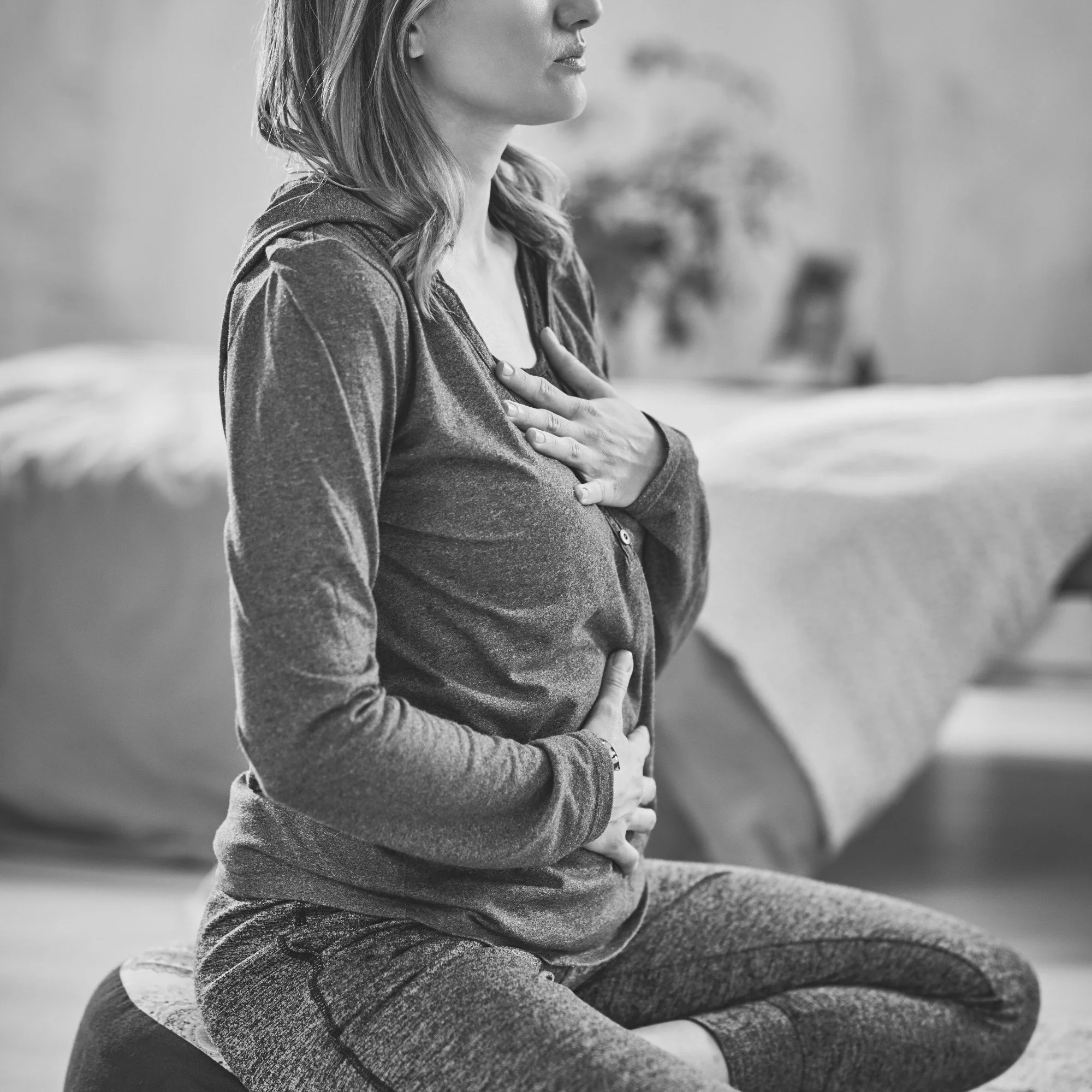
14. Hand on Heart
Placing a hand on the heart activates the body's self-soothing system.
Place one or both hands flat on your chest, feel the warmth, breathe slowly, and silently offer yourself a kind phrase (e.g. "May I be okay").
15. Orientation Check
Deliberately orienting to your environment interrupts the brain's threat response.
Look slowly around the room, name what you see, then ask yourself: "Where am I? What time is it? What day is it?" Remind yourself you are safe.
16. Physiological Sigh
The fastest scientifically documented way to reduce acute stress.
Take a full breath in through your nose, then sniff in a little more air at the top. Release it all slowly through your mouth. Repeat 2–3 times.
17. Butterfly Hug
A bilateral tapping technique that calms the nervous system through alternating stimulation.
Cross your arms over your chest with hands on opposite shoulders. Alternately tap left and right gently, breathe slowly, and continue for 1–2 minutes.
18. Body Scan
A slow sweep of attention through the body to notice and release tension.
Close your eyes and move attention slowly from the top of your head down to your feet, noticing any tension without trying to change it, and breathing into tight areas.
19. Counting Backwards
A simple cognitive task that interrupts rumination by engaging the thinking brain. |
Count backwards from 100 in 3s (100, 97, 94…) slowly and deliberately for 1–2 minutes.
20. Warm Drink Ritual
Slowly making and drinking something warm creates a mindful sensory pause.
Make a cup of tea or coffee, hold the cup and feel the warmth, inhale the steam, and drink it slowly with full attention.
21. Stretching
Gentle stretching releases physical tension and breaks the freeze response.
Roll your neck, shrug and release your shoulders, reach your arms overhead, and fold gently forward. Hold each stretch for 20–30 seconds while breathing slowly.
22. Gratitude Anchoring
Shifting attention to what is good moves the nervous system toward safety.
Think of three things you are grateful for right now, they can be very small. Say each one and notice the feeling it brings.
23. Jaw and Face Release
Tension is often stored unconsciously in the jaw and face.
Open your mouth wide, move your jaw gently side to side, relax your tongue, soften your eyes and brow, then exhale slowly through soft parted lips.
24. Deep Listening
Turning full attention to sound pulls awareness out of mental chatter.
Close your eyes and notice the most distant sound you can hear, then a middle-distance one, then the closest. Spend 2–3 minutes moving between them.
25. Alternate Nostril Breathing
A yoga breathing technique that balances both brain hemispheres and calms the nervous system.
Close your right nostril with your thumb, inhale through the left. Close both, hold briefly. Release the right and exhale through it. Inhale right, then exhale left. Repeat for 5 rounds.
26. Resource Anchoring
Linking a physical gesture to a positive memory so you can access that state quickly.
Recall a moment of feeling calm or safe, re-live it vividly, and at the peak of the feeling press your thumb and forefinger together. Repeat to strengthen the link. Use the gesture when needed.
27. Dancing or Swaying
Rhythmic movement is one of the most primal forms of self-regulation.
Put on music you love or sway in silence. Let your body find its own rhythm such as swaying, rocking, swinging your arms, for 3–5 minutes.
28. Cold Face Splash
Cold water on the face activates the mammalian dive reflex, rapidly slowing the heart rate. Splash cold water on your face 5–10 times, or hold a cold cloth to your cheeks and forehead for 30 seconds. Breathe slowly as you do it.
29. Write It Down
Externalising internal chaos onto paper reduces mental load and creates distance.
Write freely for 3–5 minutes, no editing, no judgement. When done, read it back once. Optionally, tear it up as a symbol of release.
30. Nature Noticing
Intentionally noticing the natural world reconnects us to something larger and calmer than our worries.
Step outside or look out a window. Find one natural thing, a tree, the sky, clouds, and observe it closely for 2–3 minutes, noticing movement, colour, and light.
Getting the Most Out of Grounding & Resourcing
Regulating your nervous system is a learned skill, and like any skill, it takes trial and error. Because human biology and trauma histories are incredibly diverse, a technique that instantly calms one person might feel intensely frustrating to someone else.
Finding what works for you requires a bit of experimentation. Here are some practical tips to help you personalise your approach and get the most out of these tool:
Practise When You Are Calm
We cannot overstate this: if you only try to use grounding techniques when you are heavily dissociated or in the middle of a panic attack, they will feel impossibly difficult. You must practise them when you are regulated. Try them while you are sitting on the sofa, waiting for a bus, or making dinner. Establishing these neural pathways during low-stress moments means your brain will require less effort to access them during high-stress moments.
Keep Observations Strictly Neutral
When you are using mental or physical grounding (like the 5-4-3-2-1 technique), it is vital to keep your observations completely objective and factual. Avoid assigning values, opinions, or judgements to the things you are describing.
Instead of: "I see that ugly armchair that I really need to replace." (This introduces a new stressor).
Say: "I see a blue fabric armchair with wooden legs." (This is a neutral, grounding fact). Sticking to the physical basics prevents your brain from spinning off into a new narrative.
Track Your Data (The 1-to-10 Scale)
To figure out which techniques actually work for your specific biology, treat the process like a data-gathering exercise. Before you start a grounding or resourcing practice, mentally rate your distress on a scale of 1 to 10. Once you finish the exercise, check in and rate your distress again.
Here are some things to ask yourself:
Did your number drop from an 8 to a 5? That technique is highly effective for you.
Did your number stay the same, or go up? Note that down, set that specific tool aside, and try a different category next time.
Do Not Force It
If a particular technique is not working, do not try to force your way through it. Sometimes, closing your eyes to visualise a safe place can actually make you feel more vulnerable. Sometimes, focusing on your physical body can feel too intense. If a tool is making you feel more activated, give yourself immediate permission to stop and switch to something else, like opening your eyes, standing up, or distracting yourself with a logical task.
Address the Root Cause
Grounding and resourcing are incredibly powerful tools for managing distress in the moment, but they are ultimately symptom-management strategies. They help you survive the storm, but they do not stop the storm from forming.
If you find yourself frequently relying on these techniques to cope with daily life or having this experience regularly in breathwork sessions, it is highly recommended to seek support from a trauma-informed therapist. A professional can help you safely process the root causes of your distress, expanding your window of tolerance so that you trigger less frequently in the first place.
A Note for Space Holders
As a breathwork educator or space holder, this is a reminder that your role is not to "fix" a participant's distress, but to offer them the tools to regulate themselves, fostering their own agency.
Here are some things to consider:
Teach this upfront: Dedicate time before the session begins to practice physical grounding techniques together.
Watch the room: Notice signs of dysregulation (rapid eye movements, erratic breathing, rigid body posture).
Offer choice, not commands: Instead of saying, "Calm down and ground yourself," try, "If it feels like too much right now, you are welcome to open your eyes, look around the room, and feel the floor supporting your back."
Breathwork is a powerful teacher. But the deepest work doesn't happen when we force ourselves through unbearable overwhelm. It happens when we know how to anchor ourselves safely, allowing our nervous system to process the experience from a place of empowerment and choice rather than fear.
If you want to learn how to professionally hold space using these techniques, we offer a 50-hour coach training and a comprehensive 400-hour facilitator training programme designed to deepen your practice and teach you to use grounding & resourcing in your space holding.